Stop Calling it “Stretching”
We’ve all been there: You reach down to tie your shoes and realize the floor feels much further away than it used to. Or maybe you’re on the golf course, and your “big turn” feels more like a “stiff nudge.”
In the fitness world, we throw around terms like flexibility and mobility as if they’re the same thing. But here’s the kicker: they aren’t. Understanding the difference is the secret sauce to moving better, playing harder, and staying injury-free for the long haul.
The Great Debate: Flexibility vs. Mobility
Think of it like this:
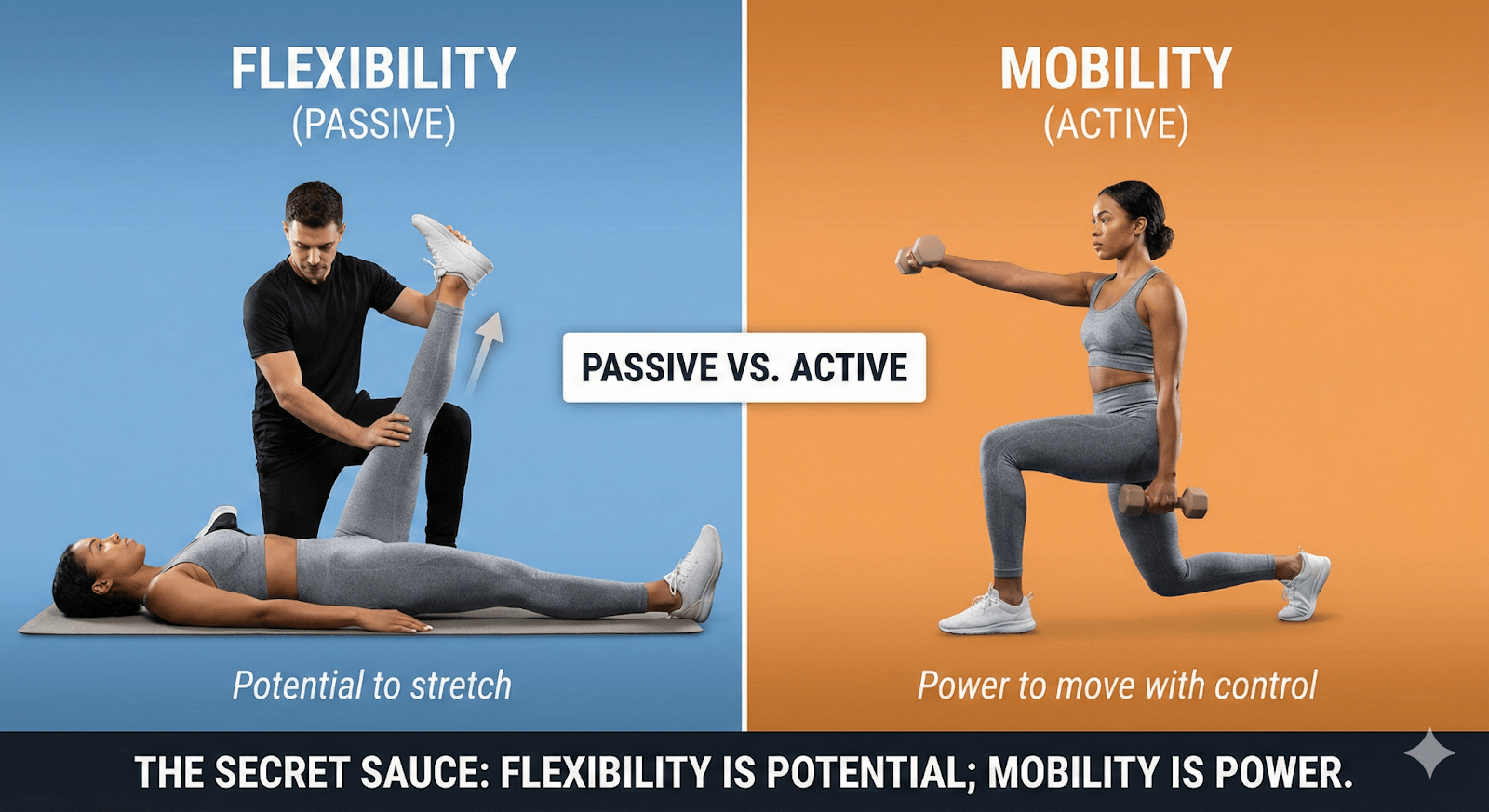
- Flexibility is your muscle’s ability to stretch passively. It’s how far a partner can push your leg up while you’re lying on the ground. It’s about tissue length and “stretch tolerance” basically, how much your nervous system will let you bend before it screams “Stop!”.
- Mobility is the real MVP. It’s the active ability of a joint to move through its full range of motion with control and strength. It’s not just about how far your leg can go; it’s about how much power and stability you have when it gets there.
 Why You Should Care
If you have tons of flexibility but zero mobility, you’re basically a floppy noodle with no engine. That “gap” between what you can stretch and what you can control is exactly where injuries happen. We don’t just want you to be bendy; we want you to be a controlled, powerful movement machine.
Your Body’s Hardware and Software
You don’t need a PhD to understand why your joints feel “locked.” It usually comes down to two things: your hardware (mechanics) and your software (neurology).
 1. The Hardware: Fascia & Joints
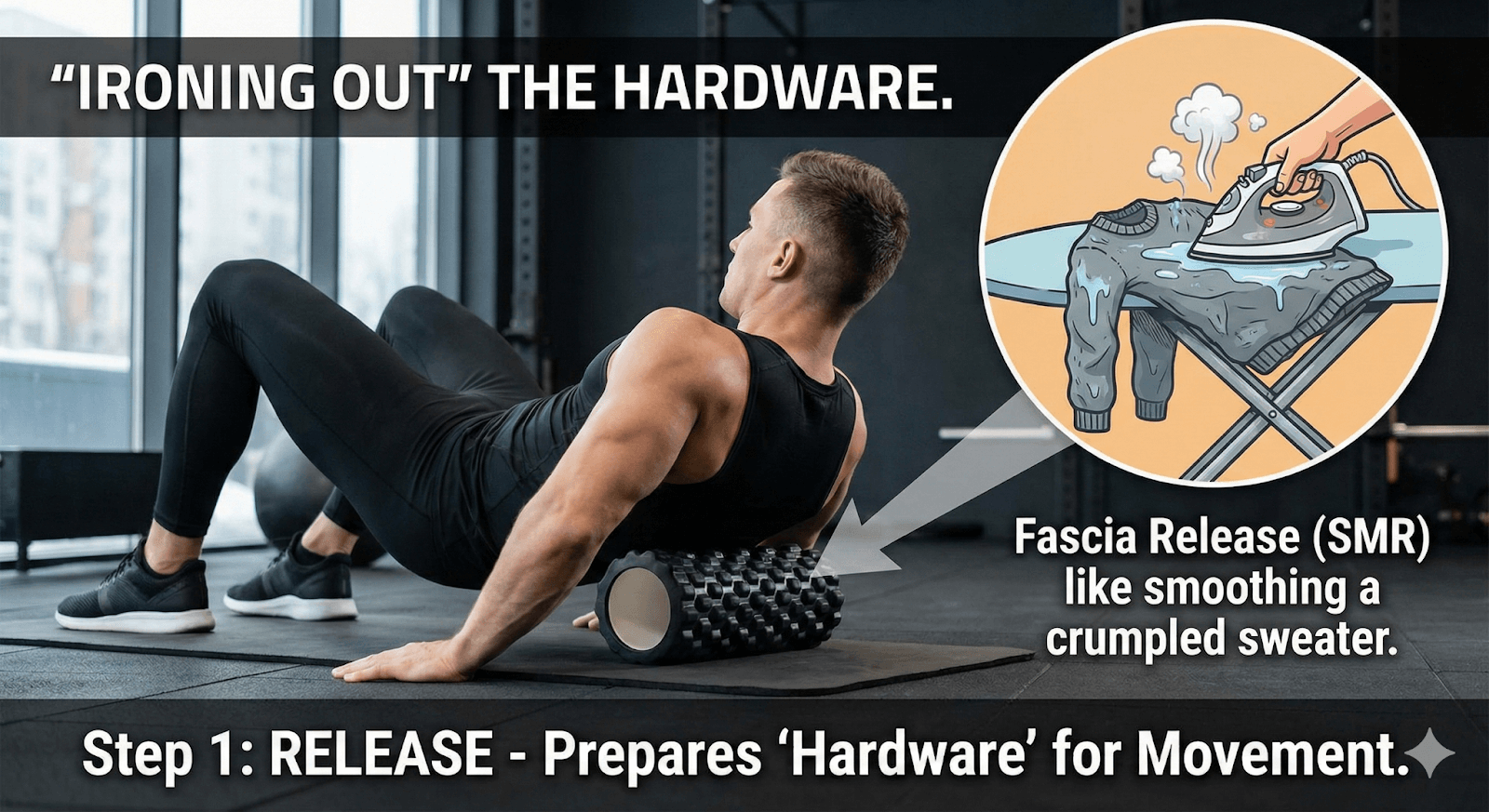
Your body is wrapped in a web of connective tissue called fascia. When you’re inactive or injured, this fascia can get “sticky” and restricted, literally gluing your joints in place. Think of it like a wet sweater that dried in a crumpled heap; it’s not going to stretch until you iron it out.
2. The Software: The Nervous System “Governor”
Your brain acts like a speed limiter on a car. It has a “stretch reflex” designed to snap your muscles back if they elongate too fast, protecting them from tearing. When we train mobility, we’re essentially hacking the software. We’re telling the brain: “Hey, it’s safe here. We’re strong enough to handle this range.”
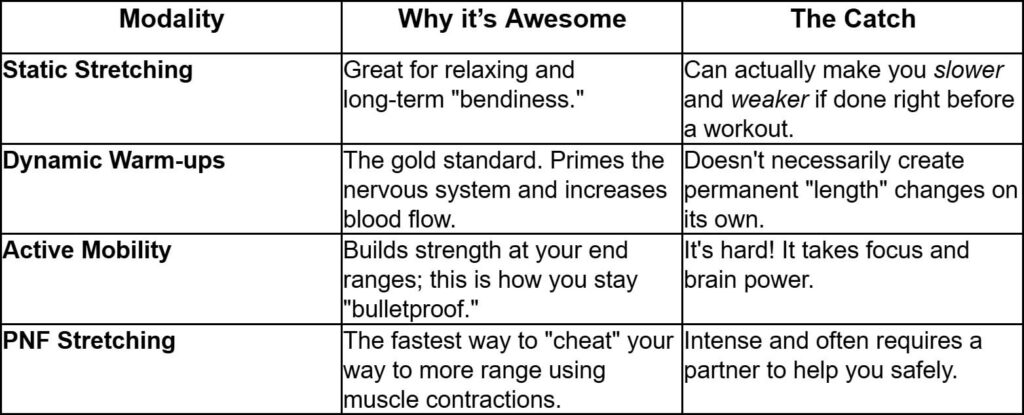
The Pros and Cons: Pick Your Weapon
Not all movement is created equal. Here’s the quick-hit guide to your toolkit:
Custom Strategies for Every Lifestyle
Whether you’re looking to maintain independence, crush it on the court, or drive the ball 20 yards further, your mobility needs a specific plan.
1. For the Active Senior: Protecting Your Independence
As we age, our tissues lose hydration and get “stiff.” This isn’t just about gym gains; it’s about functional longevity.
- The Goal: Fall prevention and gait stability.
- The Key: Ankle and hip mobility. If your ankles are stiff, you can’t react quickly to a trip or a stumble.
- Must-Do Move: The Sit-to-Stand. It’s the ultimate chair squat. Focus on keeping your chest up and controlling the descent.
 2. For the Golfer: Finding the “X-Factor”
Golf is all about “dissociation” the ability to turn your upper body while keeping your lower body stable.
- The Goal: More clubhead speed without the lower back pain.
- The Key: Thoracic spine (upper back) and hip rotation.
- Must-Do Move: 90/90 Hip Transfers. This unlocks the “rotational power” in your hips so your lower back doesn’t have to do the heavy lifting.
3. For the Pickleballer: The “Dink” & Dash
Pickleball is a game of sudden stops, lateral lunges, and quick reaches. You need to be able to get low at the kitchen line and stay there.
- The Goal: Explosive lateral speed and happy knees.
- The Key: Deceleration strength and ankle dorsiflexion.
- Must-Do Move: Lateral Lunges with a Reach. This mimics the court movement while building stability in the hips and knees.
The 10-Minute Rule
Ready to put this into action? You don’t need hours a day, but you do need a system. Research shows that for permanent change, you need about 10 minutes of cumulative stretching per muscle group, per week. Spread that out over 5–7 days, and you’re golden.
The Perfect Mobility Stack
Follow this 4-step hierarchy for your best results:
- Release (SMR): Use a foam roller or lacrosse ball to “iron out” the sticky spots for 2-5 minutes.
- Reset (Dynamic): Do some leg swings and arm circles to “wake up” the joints.
- Reinforce (Loaded): Perform deep squats or lunges to build strength in those new ranges.
- Recover (Static): Save the long, relaxing holds for after your workout to tell your body it’s time to chill.
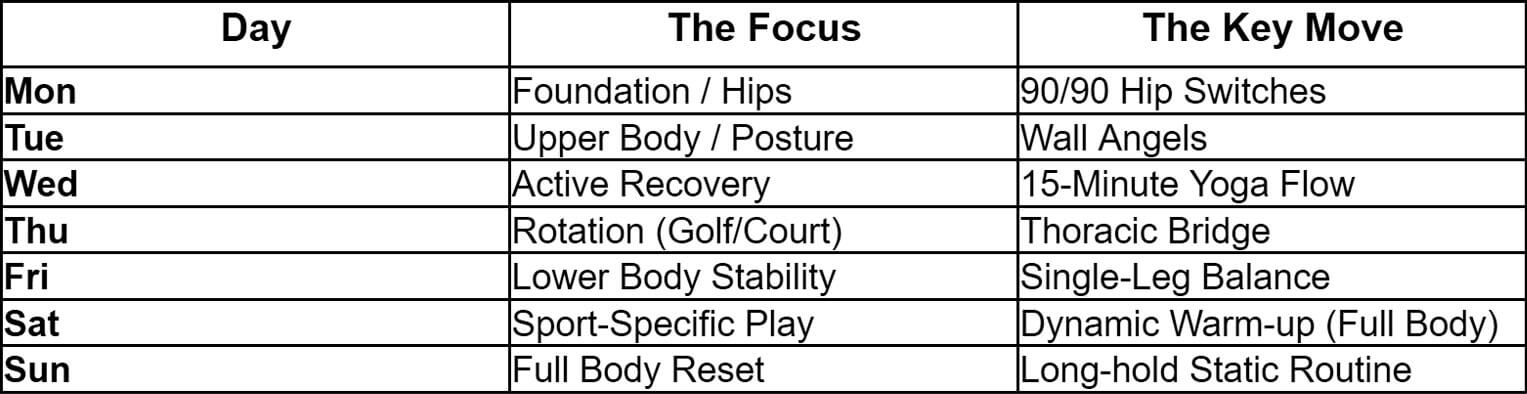
Your Sample Weekly Schedule
The Bottom Line
Flexibility is having the potential to move; mobility is having the power to move. Don’t let your body become a rusty hinge. Whether you’re chasing grandkids or a tournament trophy, don’t just stretch, train your movement.
Ready to get started?
TriCore has 3 ways to help you move with purpose:
- Schedule with one of our Personal Trainers
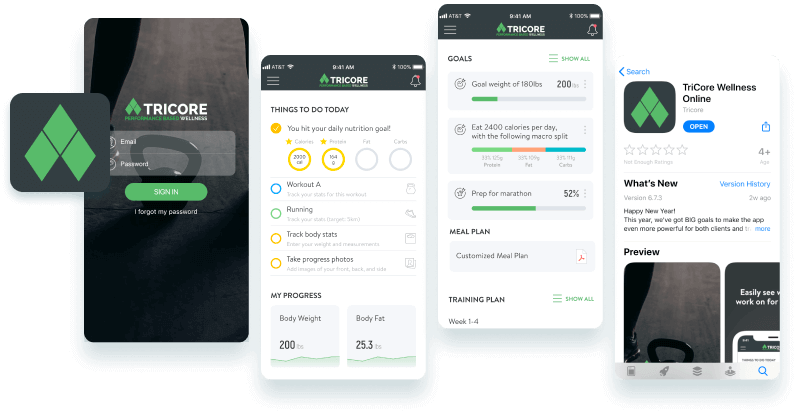
- Hire a Pro Coach and get an Online Training Program on your phone
- Book a session with one of our Physical Therapists
We have the team, tools, and technology to help you improve!
By Chris Edwards